Pulsex token burns connect trading fees with PLSX purchases and permanent removal
Pulsex token burns reduce spendable PLSX by purchasing tokens with allocated trading-fee value and permanently removing the PLSX allocated for burning from circulation. The exchange runs on PulseChain, where pool swaps generate the revenue supporting this mechanism. A collected fee, a PLSX purchase and a completed burn represent different accounting states. Pool version and fee configuration determine how much revenue can reach the buyback stage. The amount removed excludes PLSX distributed to other recipients and can include PLSX redeemed from pool shares allocated as fees. Lower circulating supply does not establish a particular market price, and a swap alone does not prove an immediate burn.
Pool versions and fee allocation
Pool version determines which fee allocation can fund PLSX purchases and which share stays with liquidity providers. The applicable setting comes from the pair and its factory.
V1's fee-accounting history
V1's launch-era fee-accounting problem diverted intended provider fees toward the buy-and-burn mechanism. The V2 launch in June 2023 introduced revised accounting for provider fees. This historical difference prevents treating the advertised allocation as a universal split across both versions. It also explains why trading activity, LP income and PLSX removal need distinct measures, even when they originate from the same swaps.
Revised fee-recipient accounting
The revised pair code enables protocol-fee accounting when the factory's
feeTo
recipient is nonzero. That code can mint liquidity provider (LP) shares to the fee recipient when reserve-product growth produces a positive allocation. These shares represent a claim on the pair's assets. Their issuance can increase LP-token supply without creating new PLSX. Fee accounting runs during liquidity operations, so a swap's fee effect and its later allocation need not share one transaction. Assigning value to a fee recipient does not itself purchase or burn the exchange's token.
What does a PLSX burn change?
A completed burn removes spendable PLSX from circulation, while market price continues to reflect trades against available liquidity. The purchase stage creates demand for PLSX; the amount actually burned becomes unavailable for resale. Selling pressure or weaker demand can accompany ongoing burns, so price can still fall.
From trading revenue to a completed burn
Trading revenue supplies the buyback only when the applicable allocation directs fee value toward PLSX purchases. The documented constant-product pair formula charges 0.29% of the input entering the pair. That charge describes the exchange fee, not the percentage of trade value subsequently burned. Provider allocations and the protocol fee recipient determine how revenue is divided. A fee percentage therefore needs its correct denominator before it can describe the burn mechanism.
Collected fee value may initially sit in the assets a pair trades or in LP shares representing those assets. The launch-era PLSXBuyAndBurn code redeems fee LP shares and converts the underlying assets into PLSX where needed. Any PLSX received directly requires no additional purchase. Revenue awaiting conversion has not yet become a PLSX removal, even if a display gives it a currency value. A buyback budget and a burn quantity use different units: the first describes resources available for a purchase, while the second counts PLSX permanently removed. They cannot be added together as a token total.
PLSX output depends on the liquidity and prices encountered during the purchase. A fixed fee budget does not specify a fixed token quantity. Larger purchases can move a pool's reserve ratio and change the effective price, while other swaps can alter conditions before execution. A displayed quote describes an expected exchange under its current inputs. The executed purchase supplies the actual output relevant to the later burn, so a forecast must distinguish estimated tokens from received tokens.
Buying PLSX transfers existing tokens into the purchasing account or contract. That transfer alone leaves them available to the recipient. The launch-era PLSXBuyAndBurn code invokes the PLSX token's burn function after any configured recipient and caller payments. Holding purchased tokens temporarily, transferring them between spendable accounts or naming an account a burn address does not establish that removal. The supply effect belongs to the actual quantity made inaccessible, rather than the fee budget or a transaction's descriptive label.
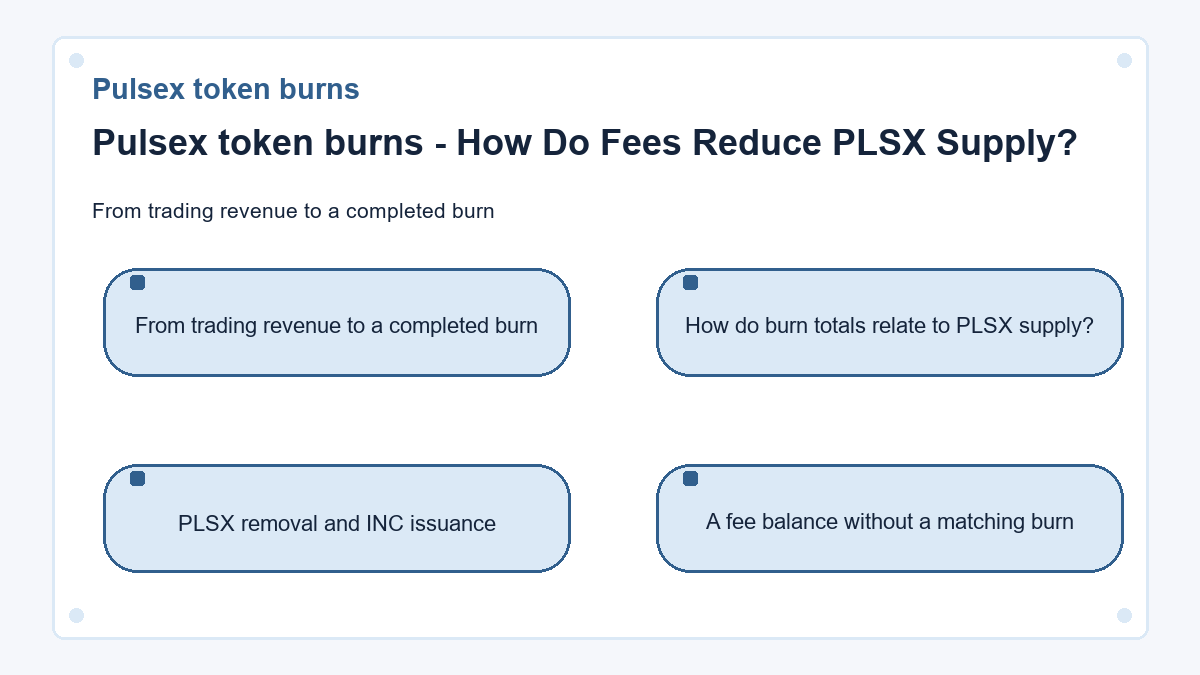
Pulsex token burns - How Do Fees Reduce PLSX Supply?
- From trading revenue to a completed burn
- How do burn totals relate to PLSX supply?
- PLSX removal and INC issuance
- A fee balance without a matching burn
The launch-era conversion performs LP redemption, any required purchases and the PLSX burn within one transaction. An exchange swap can generate fees without establishing that those fees already funded a completed PLSX burn. A cumulative total must keep amounts awaiting conversion apart from amounts already removed, and each removal must appear only once.
How do burn totals relate to PLSX supply?
Cumulative burns count completed PLSX removals, whereas a supply figure describes the token quantity included by its particular accounting definition.
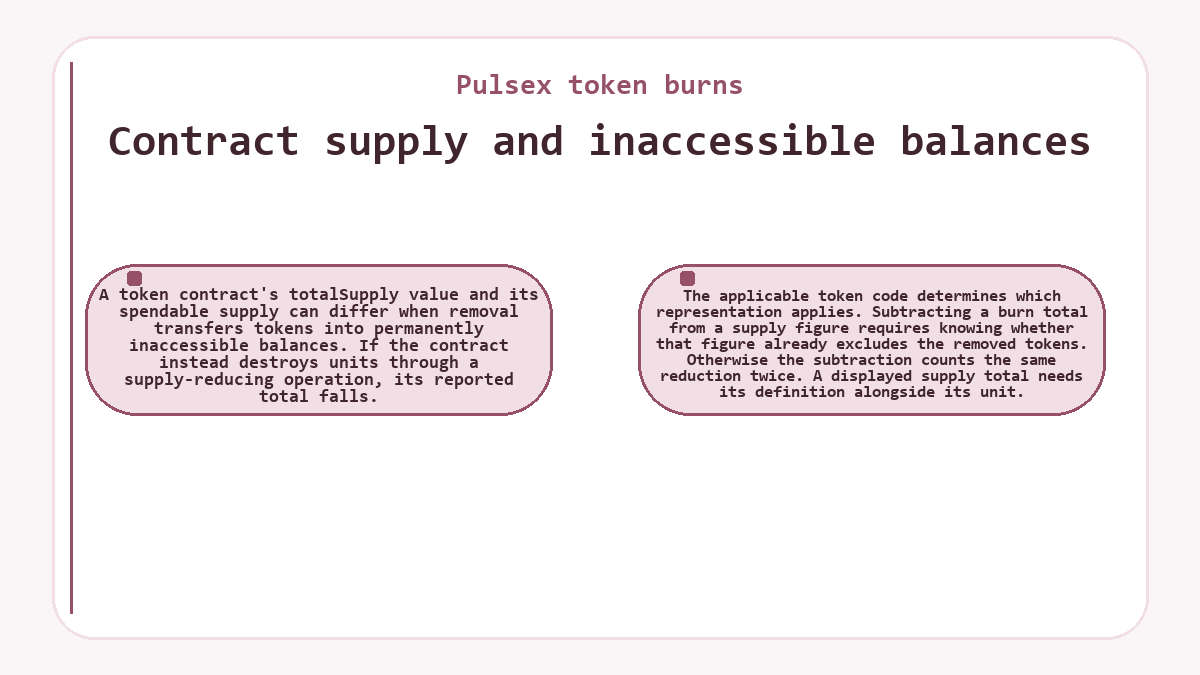
Contract supply and inaccessible balances
A token contract's
totalSupply
value and its spendable supply can differ when removal transfers tokens into permanently inaccessible balances. If the contract instead destroys units through a supply-reducing operation, its reported total falls. The applicable token code determines which representation applies. Subtracting a burn total from a supply figure requires knowing whether that figure already excludes the removed tokens. Otherwise the subtraction counts the same reduction twice. A displayed supply total needs its definition alongside its unit.
Cumulative totals and measurement intervals
A cumulative burn counter adds completed removals over its covered history. A period total measures additional removals between its starting and ending records. Comparing the two directly can create an apparent discrepancy without any change in the mechanism. Pool versions may also feed different counters or reporting scopes. Combining entries requires keeping the token, network and measurement interval consistent, then removing overlapping records. A burn percentage needs the same supply base at both ends of a comparison.
PLSX removal and INC issuance
INC emissions reward eligible farming positions and remain separate from the PLSX buy-and-burn mechanism. INC has its own token supply and a decreasing inflation schedule. Burning PLSX does not burn INC or turn an LP balance into PLSX. Adding quantities from the two tokens would combine different assets, even when the same pool activity contributes to their economics.
A fee balance without a matching burn
A fee balance alone does not establish how much PLSX has been burned. Missing transaction details leave the removal amount unresolved. Resolving a display mismatch starts with the record selection and does not require moving tokens.
- Establish the originating pool version before assigning its revenue to a buyback budget.
- Keep fee-asset amounts and LP shares separate from quantities of burned PLSX.
- Treat a completed purchase as purchased PLSX until the removal record accounts for those tokens.
- Exclude repeated or overlapping removal entries when combining cumulative burn totals.
- Stop counting an entry if its PLSX contract, PulseChain network or permanent-removal mechanism remains unresolved.
Correcting an account, network or transaction filter is a reversible way to resolve an apparent mismatch. A completed removal must identify the intended token and explain its supply effect. For PLSX on PulseChain, the token contract is
0x95B303987A60C71504D99Aa1b13B4DA07b0790ab
.
Pulsex token burns: the short answers
Does a PLSX burn credit every existing holder with more tokens?
Burning PLSX does not, by itself, add tokens to every holder's wallet. The burn quantity records units permanently removed, while a wallet balance records units belonging to that address. If a balance stays unchanged, it can represent a larger fraction of a smaller spendable supply. That change in proportion does not create a transfer or increase the wallet's token count.
Can an LP-token Burn event be counted as burned PLSX?
An LP-token Burn event records liquidity withdrawal. In the pair contract, LP shares are destroyed and underlying pool assets go to the recipient. If those assets include PLSX, transferring them to a spendable wallet leaves that PLSX in circulation. The event name therefore needs its emitting contract and underlying asset movements to distinguish pool redemption from permanent PLSX removal.
Does a routed PLSX purchase incur a fee at every pool it uses?
A purchase crossing several constant-product pairs encounters each pair's input-fee calculation. The router calculates consecutive outputs along the chosen token path, so the input to a later pair reflects the earlier swap. A headline rate for one pair does not describe the complete route by itself. The actual route and its component implementations determine the purchase's total fee effect and PLSX output.
Are PLSX buybacks funded by PulseChain gas fees?
The PLSX buy-and-burn mechanism draws on exchange trading-fee allocations, while network gas fees pay for transaction execution. PLS is PulseChain's native coin, and PLSX is the exchange's token. A transaction's gas cost does not establish an equal PLSX burn amount. Network-level changes involving PLS supply concern a different token and cannot be added to a PLSX removal total.
Will a reverted buyback increase the completed-burn total?
A fully reverted transaction does not complete its attempted PLSX purchase or burn. Gas can still be charged for the failed execution, so a network fee is not proof of token removal. Earlier confirmed fee collections or burns remain separate records. A submitted transaction hash identifies the attempt; its final status and token effects determine whether any new removal belongs in the completed total.
Why can the currency value of a PLSX burn change later?
The same burned PLSX quantity can have different currency valuations at different token prices. A valuation using the purchase's execution price describes that purchase's value at execution. A valuation using a later market price reprices the same token quantity. Neither calculation creates another burn. Comparing token units separately from currency values avoids mistaking price movement for an additional removal from circulation.