Pulsex liquidity pools for a first paired deposit
Pulsex liquidity pools accept paired deposits on PulseChain and issue liquidity provider (LP) tokens representing a share of the pool. A first contribution needs both selected assets, any required spending permissions and PLS for gas; existing reserves set deposit proportions in a funded pool. Completion means the intended recipient receives LP shares; future trading income depends on pool version and activity.
A first contribution from your wallet differs from the first deposit ever made into a pair. Existing reserves determine deposit proportions in a funded pool. An unseeded pair also needs an initial price, which its first provider establishes.
In short: Redeeming LP tokens returns a share of the pool's current assets, so withdrawal quantities can differ from the original deposit.
Two asset balances and a verifiable pool receipt
Two asset balances on PulseChain are the starting requirement for a conventional paired deposit. For contract-based assets, each balance must match an underlying token contract the selected pair holds. The pair's
token0
and
token1
fields identify those assets. Pool version matters because separate deployments can assign trading fees differently. Separate pair contracts maintain their own reserves and LP supplies.
Native PLS pays network execution costs even when neither contributed asset is PLS. When the contribution also includes native PLS, its deposit amount and gas draw on the same balance. The classic router implementation wraps contributed PLS into WPLS before sending it to the pair. Ordinary spending permissions apply to contract-based tokens and must cover the amounts the chosen deposit operation needs to move. For a deposit delivering shares to your wallet, a successful transaction and the LP mint establish receipt. A wallet balance for that pair then shows the shares you currently hold.
Reserves, LP shares and the pool claim
Pool reserves are the underlying token amounts the pair holds for trading, while LP tokens record a transferable claim on those assets. Your LP balance divided by total LP supply expresses your fraction of the pair. PLSX is the exchange's token, whereas an LP token belongs to a particular pool.
Deposit proportions before signing
A pair with funded reserves
An existing pool uses its reserve ratio to establish matched contributions. Equal value at the pool's price usually means different token quantities, and decimals determine how displayed amounts translate into raw contract units. Matching the same visible number on both sides can therefore produce an unbalanced contribution. Reserve ratios can change before execution. For a deposit through the classic router implementation, set desired amounts, minimum accepted amounts and a deadline before signing. In a funded pair, the router adjusts one contribution to current reserves and rejects an adjusted amount below its minimum. Execution after the deadline also fails. The mint calculation uses the balances present when it runs.
A pair without initial liquidity
The first provider sets an unseeded pair's starting price through deposit quantities. A ratio differing from other venues can create an arbitrage opportunity.
Your first wallet contribution needs an opening price only when the pair itself remains unseeded; a funded pool follows its existing proportions. Pair creation and initial funding are distinct states; an existing pair address alone does not establish funded reserves.
What determines the LP tokens you receive?
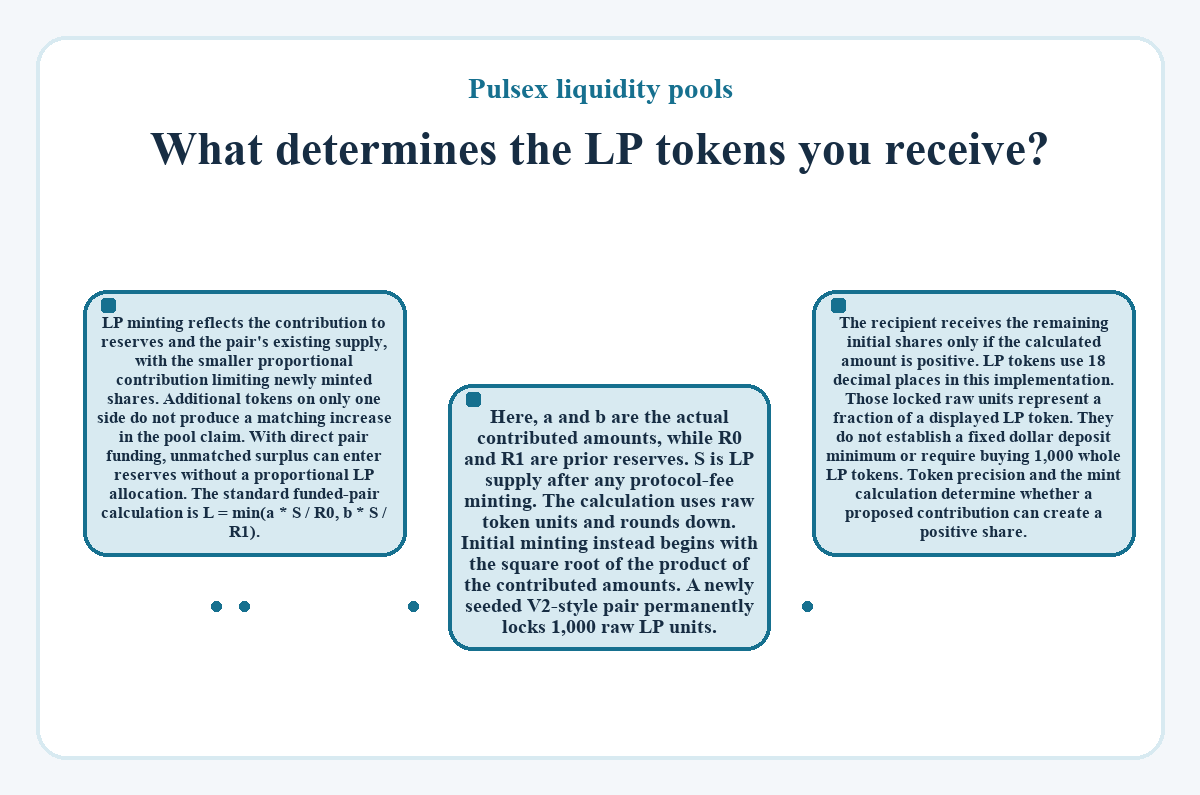
LP minting reflects the contribution to reserves and the pair's existing supply, with the smaller proportional contribution limiting newly minted shares. Additional tokens on only one side do not produce a matching increase in the pool claim. With direct pair funding, unmatched surplus can enter reserves without a proportional LP allocation.
The standard funded-pair calculation is
L = min(a * S / R0, b * S / R1)
. Here,
a
and
b
are the actual contributed amounts, while
R0
and
R1
are prior reserves.
S
is LP supply after any protocol-fee minting. The calculation uses raw token units and rounds down.
Initial minting instead begins with the square root of the product of the contributed amounts. A newly seeded V2-style pair permanently locks 1,000 raw LP units. The recipient receives the remaining initial shares only if the calculated amount is positive.
LP tokens use 18 decimal places in this implementation. Those locked raw units represent a fraction of a displayed LP token. They do not establish a fixed dollar deposit minimum or require buying 1,000 whole LP tokens. Token precision and the mint calculation determine whether a proposed contribution can create a positive share.
V1 and V2 trading-fee accounting
Pool version determines how swap-fee growth benefits a liquidity position. Classic V1 and V2 pair implementations apply a 0.29% fee to the swap input amount.
V1's launch-era fee issue
The fee-accounting issue identified in V1 around the June 2023 V2 launch diverted providers' fee growth into protocol fee accounting when protocol-fee minting was enabled. That accounting supported the PLSX buy-and-burn mechanism. Applying V2 provider-income assumptions to a V1 position under that fee-on model therefore misstates its fee treatment. Farm rewards require separate consideration.
V2's provider allocation
V2 introduced corrected provider accounting. Under its fee-on model, the nominal allocations are 0.22% of swap input for LPs and 0.07% for the protocol. The pair mints protocol LP units during liquidity additions or removals if recorded reserve growth produces a positive allocation. The factory's
feeTo
setting controls whether this protocol-fee minting operates. Retained fee value forms part of the underlying pool balances.
Permission and pool ownership after a first deposit
A first contribution to a funded pair can involve approving a token spender and submitting a paired deposit. Approval changes permission over the selected token, while the liquidity deposit creates shares in the selected pair. Both actions can produce transaction records, with different consequences for ownership.
Before submission, the paired deposit depends on both token balances, any necessary allowances, the live reserve ratio and PLS for gas. The minting relationship remains the same while balances and reserves change. An allowance recorded earlier remains permission; it does not establish that these deposit conditions remain satisfied.
A transaction hash identifies an attempt, while its receipt records whether execution succeeded. Successful approval execution records the allowance; the paired deposit's execution must include the intended liquidity mint. A success notification for the first action does not settle the second.
| Pool-related action | On-chain outcome |
|---|---|
| Approve a token spender | Permission to spend the selected token; no LP mint |
| Add liquidity to a funded pair | LP shares for a proportional contribution to existing reserves |
| Seed an unfunded pair | Initial LP shares with a permanently locked minimum |
| Deposit eligible LP tokens into an active farm | Farm custody of LP tokens and a separate eligible reward position |
| Redeem available LP tokens | LP shares burned for proportional underlying token balances |
| First-deposit completion | Successful liquidity execution and LP shares received by the intended recipient |
The LP token's mint transfer identifies the receiving address independently of any promised yield. When shares remain in that address, its pair-token balance confirms the holding.
Can trading fees offset impermanent loss?
Trading fees can offset impermanent loss when retained income exceeds the shortfall against holding the original assets. Swaps change the proportions of the underlying tokens. As their relative price moves, the provider's claim can contain less of the appreciating asset and more of its counterpart.
A constant-product liquidity position can underperform holding the same initial assets when their relative prices move. Impermanent loss compares the position with holding the original assets, so a shortfall can exist even when both have gained dollar value.
Fee income depends on trading activity, the retained fee allocation and the position's share of liquidity. Additional providers and protocol-fee minting can change that share. Compare the pool position and the original holdings on the same valuation basis. Gas costs and any farming rewards then require their own treatment.
INC rewards require an eligible farming position
INC rewards require depositing an accepted LP token into an active farm. Minting an LP token establishes the pool share without creating that farming position. Eligibility belongs to the LP contract a particular farm accepts, which a version label or familiar asset symbol cannot establish.
Farming places LP tokens in farm custody and introduces separate reward accounting. Reward emissions and INC's market value affect farming returns separately from the pool's underlying assets. A first paired deposit can stop with LP tokens held in the wallet, leaving the pool position outside farm custody.
LP balances and token quantities after execution
LP balances and underlying token balances describe different holdings after a deposit. The pool holds the contributed assets, while wallet-held LP tokens represent the claim on them. A wallet may omit a received LP token from its display. Its absence there does not alone establish a failed mint. A manual token import changes the wallet display without changing on-chain ownership; the pair contract records the recipient's LP balance. Later LP transfers or farm deposits can change where those tokens reside. Mint and transfer records expose this address activity publicly, including the pool involved.
Why can a paired deposit fail before LP tokens appear?
A paired deposit can fail when assets are unavailable, token transfers are rejected or minting produces no positive share. The low-level mint calculation reads actual increases in the pair's underlying balances. Missing one contribution can leave no mintable liquidity. Very small contributions can also round down below the amount required for a positive mint.
If a selected token charges a transfer tax, the amount reaching the pair can differ from the requested contribution. The mint calculation uses the received balance increase. Transfer restrictions can also prevent funding or redemption. These token-specific mechanisms affect the actual contribution independently of the amount displayed in a preparation screen.
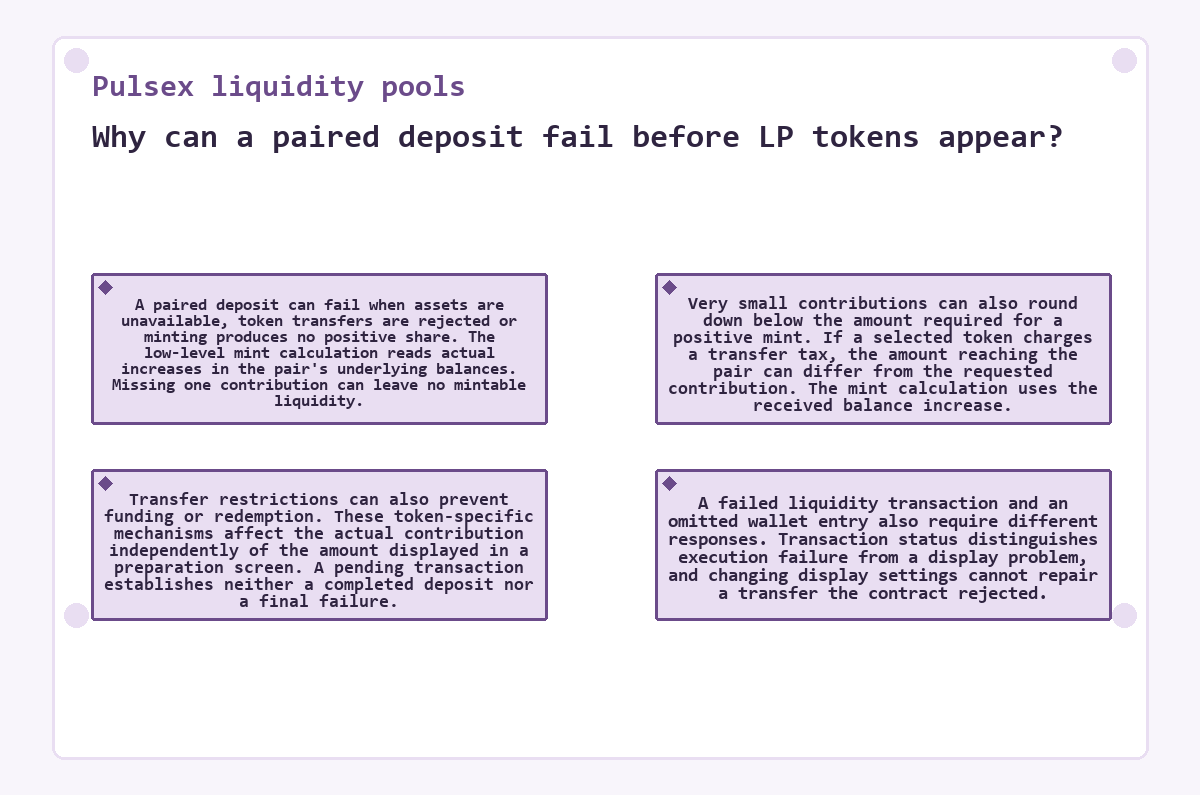
A pending transaction establishes neither a completed deposit nor a final failure. A failed liquidity transaction and an omitted wallet entry also require different responses. Transaction status distinguishes execution failure from a display problem, and changing display settings cannot repair a transfer the contract rejected.
An exit through the pool's current balances
Liquidity can remain as unstaked LP tokens after the first deposit. Holding those shares in the wallet retains the pool claim without adding a farm position. Pool activity can continue changing the underlying asset mix while the number of shares in that wallet remains unchanged. Redemption burns LP units against a proportion of both underlying token balances at withdrawal. The calculation uses LP supply after any protocol-fee minting required by the pair. Withdrawal therefore reflects the pool's current holdings, including its applicable fee accounting. It can return different token quantities from the initial contribution.
A farm-held position requires access to its LP tokens for redemption, subject to that farm's withdrawal conditions. Token transfer restrictions and gas requirements still apply at exit. Removing liquidity ends participation in the redeemed share, returning the asset mix the pool holds at withdrawal.
Popular questions about Pulsex liquidity pools
Can a V1 LP token be used as a V2 pool share?
A V1 LP token cannot stand in for a V2 LP token because each belongs to its own pair contract. Even when both versions hold the same underlying tokens, their receipts represent separate reserves and supplies. Moving liquidity between versions involves redeeming one pool position and contributing to the other. Transferring the old LP token alone preserves its original pool claim.
Which wallet owns the pool claim after an LP token transfer?
The wallet receiving LP tokens acquires the associated share of that pair. The claim follows the LP balance, so the original deposit record does not establish continuing ownership after a transfer. Transferring LP tokens also leaves the underlying assets inside the pool. Those assets move to a recipient when the corresponding shares are redeemed.
Are LP token amounts comparable across different pairs?
LP token amounts alone do not provide a common measure of value across different pairs. Each pair has its own LP supply, reserves and underlying assets, so the same receipt amount can represent different claims. Comparing positions requires valuing each position's underlying asset share. A shared PLP symbol does not combine those separately issued pool claims.
Is concentrated price-range selection part of a V2-style paired deposit?
A V2-style paired deposit creates a proportional pool claim without a position-specific price range. The classic pair calculates shares from token contributions, reserves and LP supply. It does not accept upper and lower price ticks for an individual position. Deposit proportions and later relative price movements affect the holding, while neither selects a concentrated liquidity range.
How can a token transfer to the pair leave no LP position?
A direct token transfer can increase the pair's balance without minting LP tokens. The pair's mint function creates the pool shares, so an underlying-token transfer record establishes only that those assets moved. Without LP units minted to your intended recipient, that transfer has not created your pool receipt.